Accountability is the real engine of performance that drives growth
Reading time: 4 min.
Most leaders agree that accountability matters. Few understand just how much it determines performance, profitability, and long-term success. And even fewer know how to build it.
Accountability is not a soft concept. It is a behavioural and cultural system that determines whether a company scales or stalls. It is also one of the biggest sources of avoidable loss in modern organizations.
Gallup (source) estimates that lack of clarity and accountability contributes to 8.8 trillion USD in lost productivity every year. And clarity of expectations is a key driver of accountability.
And the financial impact goes even deeper: organizations with strong accountability cultures report up to 22 percent higher profitability and stronger margins (AMA and Center for Talent Innovation).
Accountability is structural. It is economic. And most organizations are dramatically under-leveraging it.
Accountability is not innate
Some people feel naturally responsible for outcomes, while others do not operate that way. Not because they resist working hard, but because:
- They are driven by different internal motivators
- They require more clarity than others
- They fear making mistakes
- They do not feel safe speaking up
- They have never worked in a culture where accountability was clearly modeled
This is why relying on “hire people who are accountable” is not a strategy.
Accountability is not a personality trait. It is a learned discipline supported by expectations, systems, and leadership.
Accountability builds trust faster than competence
People judge you on whether you do what you said you would do. This is how colleagues, clients, and boards evaluate reliability.
- Following through signals integrity
- Owning mistakes builds credibility
- Avoiding responsibility erodes trust even when performance is strong
For leaders, your reputation for accountability often matters more than output. It becomes a reflection of character.
Why people struggle with accountability
Most accountability gaps are predictable and behavioral, not moral. Here are the most common causes.
1. Unclear expectations
- Success criteria are vague or shifting
- Priorities are unclear
- People do not know what “good work” looks like
2. Low psychological safety
- Speaking up about delays or risks feels dangerous
- People fear consequences more than they value transparency
3. Conflicting priorities
- Everything is urgent
- People triage based on survival rather than commitment
4. Lack of skill or capacity
- Employees do not feel safe admitting they need help
- They avoid responsibility to avoid exposure
5. Cultural norms
- Leaders overpromise or miss deadlines
- Standards appear optional
- People follow the behavior they see
These are design issues. Not attitude issues.
The three mechanisms of accountability
Organizations create accountability in three ways. Most use only one.
1. Punitive accountability (control-based)
This relies on rules, monitoring, and consequences.
How it works
- Rules are clearly defined
- Enforcement is strict
- Breaking rules leads to painful consequences
Pros
- Produces fast results
- Ensures high compliance when the enforcer is present
- Works in high-risk environments where precision is critical
Cons
- Behavior collapses when the “stick” disappears
- Creates resentment and passive compliance
- Demotivates high performers
- Encourages hiding mistakes, defensiveness, and finger-pointing
- Reduces trust and creativity
Punitive accountability ensures compliance but rarely produces performance.
2. Effective accountability (intrinsic and cultural)
This is built on clarity, ownership, and coaching.
How it works
- Expectations are discussed and adjusted often
- Feedback is normal and two-directional
- People surface issues early
- Mistakes are acknowledged without shame
Pros
- Builds self-driven accountability
- Increases trust and collaboration
- Reduces managerial policing
- Strengthens long-term performance
Cons
- Requires leaders who model accountability
- Requires direct, respectful conversations
- Requires consistent expectation-setting
- Can feel slower at first while habits change
This is the version of accountability that scales sustainably.
3. Structural accountability (the missing layer)
This is the mechanical backbone of consistent performance.
How it works
- SOPs and checklists
- KPIs and scorecards
- Dashboards and visual controls
- Daily huddles and weekly commitments
- Monthly review cadences
Structural accountability makes the right behavior easy and the wrong behavior harder. It removes friction from follow-through.
A framework to build accountability
1. Clarify expectations relentlessly
- Define roles, deliverables, deadlines, and success criteria
- Put commitments in writing
- Make ambiguity unacceptable
2. Build psychological safety
- Normalize speaking up about delays or risks
- Leaders model transparency by owning their own misses
3. Implement structural systems
- Use weekly priorities
- Track KPIs visually
- Adopt SOPs and clear operational rhythms
- Conduct regular post-mortems
4. Strengthen accountability conversations
- Teach managers to give direct, respectful feedback
- Encourage early course correction instead of late confrontation
- Train employees to receive feedback without defensiveness
5. Reward ownership, not perfection
- Praise people who surface issues early
- Recognize those who take responsibility openly
- Discourage hiding problems
6. Apply consequences fairly
- Make consequences predictable and proportionate
- Focus on behavior change, not punishment
- Escalate only when accountability is repeatedly ignored
The goal is to protect standards and fairness, not to shame anyone.
Leaders must model accountability first
A culture of accountability collapses the moment senior leaders:
- Miss deadlines
- Break commitments
- Avoid owning mistakes
- Apply rules inconsistently
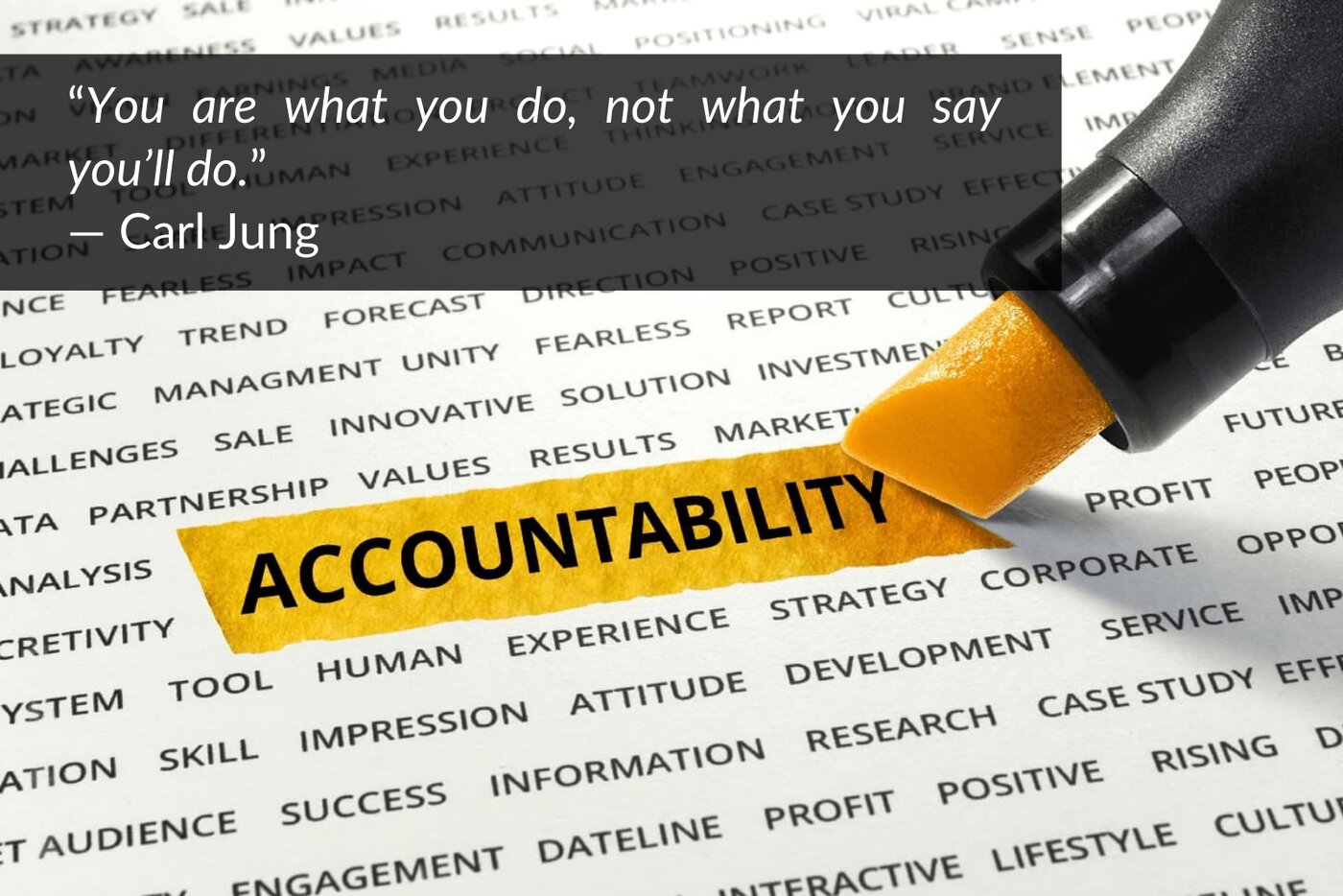
People watch what leaders do. Not what they say.
If leaders model accountability, the organization follows.
If leaders avoid responsibility, no amount of policies or consequences will fix the culture.
Accountability is everyone’s job. But managers must design the conditions where accountability is the norm.
The bottom line
Accountability is clarity plus ownership plus trust.
Organizations that master it grow faster, operate more efficiently, and protect their margins.
Organizations that ignore it pay for it in rework, turnover, conflict, slow execution, and inconsistent performance.
If you want stronger execution and better teamwork, the path is clear:
Build a culture where people keep their word because they want to, not because they fear the alternative.